SEE THE EVENTS PAGE FOR 'DATES FOR YOUR DIARY'

LETTER FROM THE CHAIR
Greetings and welcome to our March Newsletter.
Spring has sprung! The days are getting longer and warmer (hopefully!) and my daffodils are out. Also, it is time of the year for our AGM as required by the u3a Constitution. It will be part of our monthly Speaker Meeting on the 10th and remember there is no door charge, so it is FREE entry.
There are many of the usual events during the year but it is also our 20th year, so look out for the special Anniversary celebrations.
Unfortunately, not everybody is as nice as we are and fraud is on the increase. Beware of criminal activity. It seems that we need Passwords for everything, so use strong ones that include numbers and punctuation marks. Never give personal details over the phone or at the door, and never give bank account numbers. Ignore offers or pressures to act quickly.
If you think you have been a victim, record it and ask Citizens Advice or bank. Stay safe!
See you at the AGM,
Richard Lewis
Chair
Richard Lewis Chair Furness u3a
Membership Renewals 2026-7
Membership renewals will be open immediately after the Furness u3a AGM on Tuesday 10 March 2026. The last day for renewing will be Thursday 30 April 2026, a period of 7 weeks.
An email will be sent to you before the AGM giving you information that will be helpful to you when renewing.
Renewal methods will be:
- Online (preferred) by debit/credit card or using a PayPal account
- In person after the AGM and Speaker on Tuesday 10th March at The Coro, Ulverston
- In person at the 14th April monthly speaker meeting from 9.30am-10.15am
- By bank transfer. Please do not make a bank transfer before Tuesday 10 March.
(We don't know the fee for next year yet) - By post using a cheque
Before you renew, please let me know if there have been any changes to your:
Telephone / mobile number, email address, postal address, Gift Aid eligibility.
If you have decided to discontinue your membership for next year, please contact me
Linda Marshall Membership Secretary
NEW COMMITTEE MEMBER
Hello, my name is Dawn Morris, and I’d like to introduce myself as your new Welfare and Inclusion Officer.
I retired from the NHS in 2024, where I was heavily involved in staff wellbeing. I devised and ran a programme called Fantasy Feelgood, which promoted that aspects of wellbeing were individual to you and it was ok for your choices to be different from your colleagues (just like Fantasy Football – I worked mainly with men!). When I was in my 50’s, I embarked on a Master’s Degree in Healthcare Leadership and my dissertation subject was staff wellbeing. During Covid, I was chosen as one of six Staff Wellbeing Leads for the Trust and the only non-clinical lead. Following on from that I was part of the Steps4Wellness Champions, promoting and supporting staff wellbeing across the Trust.
I was also an advisor to the Equality, Diversity and Inclusion Group, representing stammering and supported the Stammer UK campaign of ‘No Diversity without Disfluency’, achieving an amendment to the Trust’s EDI policy for the inclusion of disfluency. As you may have guessed from that, I have a lifelong stammer, which I eventually addressed in 2021 and sought speech therapy, where, after months of therapy, I had a ‘miracle moment’. I now have tools I can use to mostly overcome my stammer and a new mindset of ‘so what’ if I do occasionally stammer.

Last year, I acquired some food intolerances following a bout of illness, which has opened my eyes to the difficulties of finding places to eat which cater for my needs, with varying levels of success.
I am a champion of hidden disabilities, which are often not spoken about. It’s obvious if you have broken your leg, but not so obvious if you are struggling with anxiety, or have a heart issue. Whatever the issue, always remember to be kind to each other as you never know what is going on for someone behind their smile.
As your Welfare and Inclusion Officer, I hope to help anyone who has additional needs to ensure they feel included within the Furness u3a. There may be limits as to what can be achieved but be assured that I will make every effort to accommodate changes wherever possible. I will endeavour to support all members to achieve equal access to groups, activities and events. This can range from bringing a carer or assistance dog with you, through to where you need to sit at a meeting or letting us know of any dietary requirements.
At the February monthly meeting, I arranged for a separate screen to display the speaker’s presentation for a member with a vision impairment who was struggling to see the main presentation screen, this allowed her to angle the screen for her specific requirements.
If you have been struggling with something, which you think could be addressed, let me know and together we may be able to resolve it.
Dawn Morris Welfare and Inclusion
GROUP NEWS
Chess Group
We are having a slow burner with starting a Chess Group so anyone interested please contact me.
Someone did contact me but I have misfiled the email, sorry, please email me again.
Duncan Platts Groups Liaison
QUESTERS
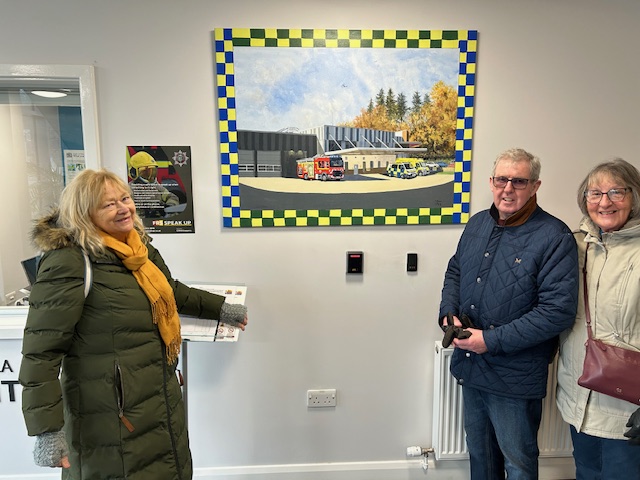
The Blue Light Hub story continues.... On the Questers second tour of the Blue Light Hub, Tim found out about an interesting (local) story about this original painting by Catherine McKay hanging in the reception. This is what Netty Garforth told Tim.
"Catherine McKay is a well-known local artist who has exhibited her work many times. She is now in a care home but continues to sketch & paint. A few years ago, 2 fire officers called at the her home to install fire alarms and were admiring the paintings displayed in her home. They asked if she would do a painting to display in the entrance of the new Blue Light Hub to represent all three of the emergency services with their crests. Catherine photographed an appliance turning out for a call and from it produced the painting we now see on display."
Netty, Paul and Janet are in the picture.
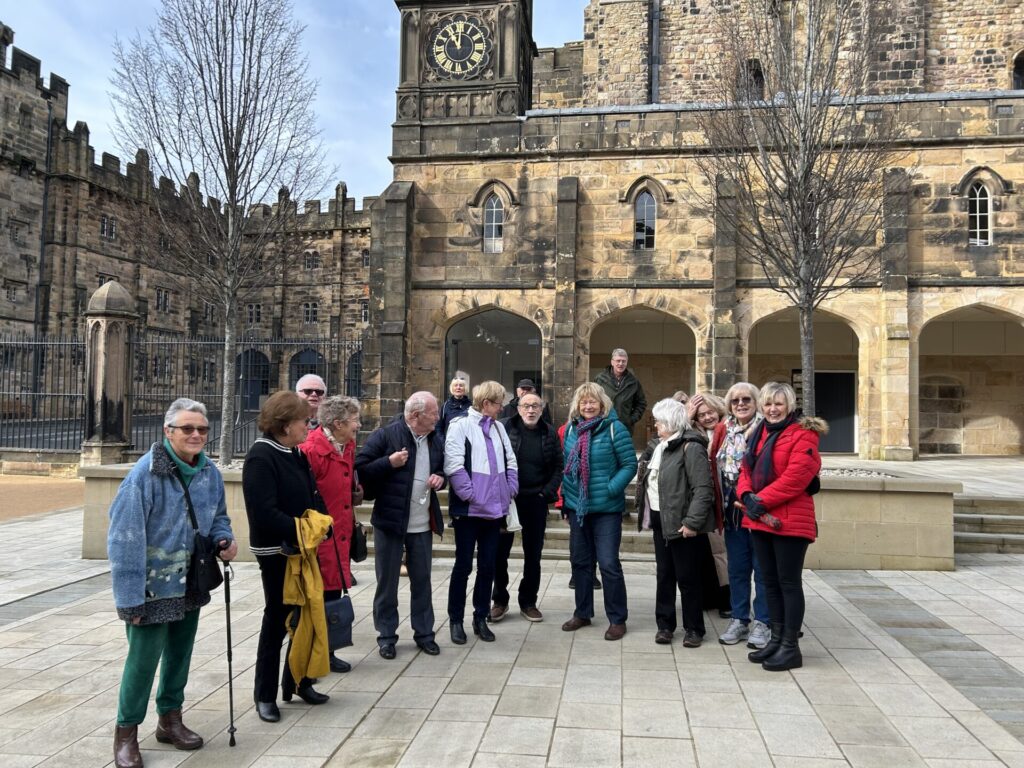
The Questers February visit was organised by Margaret Helm and our grateful thanks go to her for a splendid visit to Lancaster Castle.
We had a private tour for the 24 members who attended and were lucky to get an excellent guide who really knew his subject. The castle is huge, and we were told how some sort of fortification has been on that site since Roman times. The castle has served as a prison for centuries and we learned a lot about life in prison, prison reform and even some of us got locked in a tiny cell with
absolutely no light, fortunately only for a few minutes before being released. We were shown the magnificent Crown court and the less magnificent Assizes court with its branding iron for the guilty. We learned about some of the more gruesome things that went on including seeing chains, leg irons etc and we ended our tour in the Drop Room where prisoners were taken before going to the gallows outside to provide entertainment for the local populace.
Our next visit is somewhat more gentle, as Win Postlethwaite is organising a trip to the “Growing Well” project at Sizergh Castle. This is a charity who aim to help people experiencing mental health problems overcome them through horticulture. The visit this time will be on Friday the 20th March, not our usual Thursday, and due to it being so popular we are already becoming over subscribed. However, if you would like to put your name down for the reserve list, please contact Win Postlethwaite Further details will be sent out nearer the time.
Sue and Tim
Please see the Questers Group page for details, or contact Tim Evans
FELL WALKERS
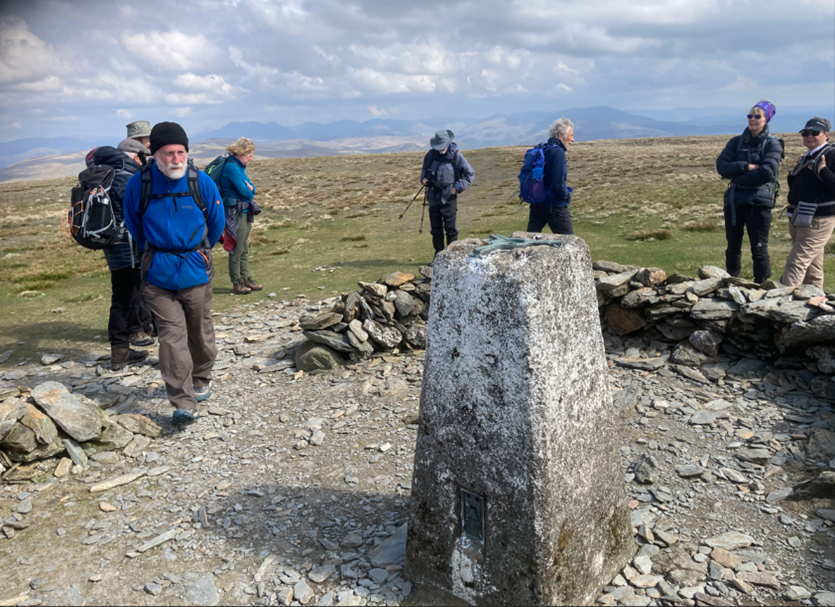
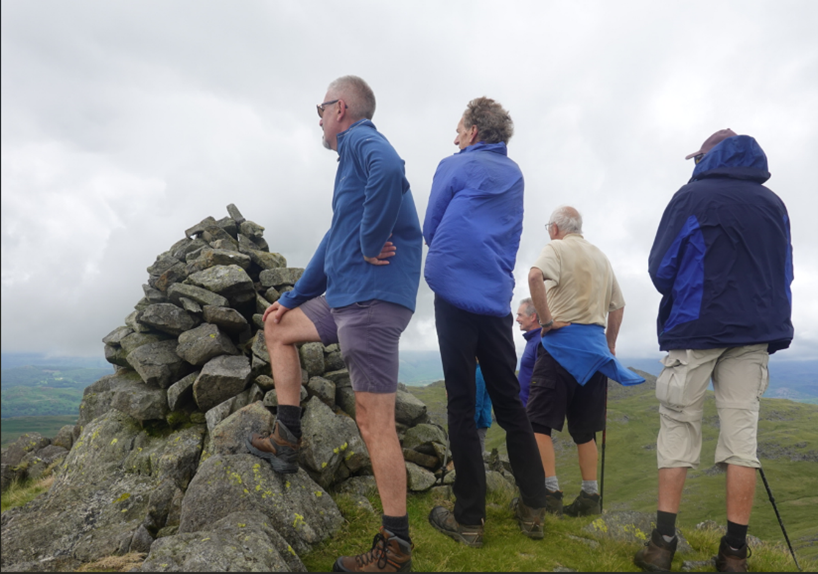
u3a Fell Walkers 2026 Season starts on 25th March!
The u3a Fell Walkers group will soon be heading out into the fells again! As usual, we will walk on the 4th Wednesday of the month, from March to November inclusive.
The programme is shown below.
Wednesday 25th March Ingleborough, led by Neil McLaughlin Cook.
Wednesday 22nd April Langdale Pikes, led by Christine and Phil Newton.
Wednesday 27th May Middle Fell & Seatallan, led by Viv Muzalewski.
Wednesday 24th June Seathwaite Round, led by Jules Maire.
Wednesday 22nd July Crinkle Crags, led by Dave Kyles.
Wednesday 26th August Gibson Knott & Calf Crag, led by Neil McLaughlin Cook.
Wednesday 23rd September Angle Tarn Pikes, led by Meg and Pete Owens.
Wednesday 28th October The Howgills, led by Tony Lashmar.
Wednesday 25th November Dunnerdale Horseshoe, led by Meg and Pete Owens.
New members are always welcome. If you would like to join the group, please contact Neil McLaughlin Cook by emailing Neil Mclaughlin Cook .
LOCAL HISTORY GROUP
Local History Group - Meeting 9 February 2026
Speaker – Neil Whalley, ‘’Gleaston Castle and the Manor of Muchland
A well turned out meeting at Croftlands Community Hall took place on Monday afternoon. Neil explained with the help of a map of the southeastern corner of low Furness, known as Muchland in ancient times, with its four manors located. Muchland enclosed the lower Furness villages of Bardsea, Urswick, Scales, Stainton, Sunbrick, Baycliff, Gleaston, Aldingham, Dendron, Leece, and Newbiggin. Muchland gets its name from Michael’s land after Michael le Fleming the land being granted to him by Henry1 around 1107 and 1111.
Illustrated family timeline charts were also used to explain the fascinating history behind the events and personalities involved.
Aldingham and Gleaston Castle were at the centre of Furness’s significant manors, often overlooked or even misunderstood and little known generally. The ownership of these sites, beginning with the now eroded Norman motte, Aldingham Hall and Gleaston Castle have been under a number of distinguished families by inheritance and marriage with the site ending in private property today with the adjacent farm.
Administration of Muchland was in the 12th century from Aldingham manor and in 1291 came into the ownership of the Harrington family. During the 14th century the Scots laid waste to Furness and along with coastal erosion the Norman Motte was abandoned and administration then moved from Aldingham Hall to Gleaston Castle.
The original mention of Gleaston Castle was in 1389 and possibly built for John Hartington 1st Baron, the 2nd Baron died there in 1363. It is not thought to be a defensive structure. There is archaeological evidence of buildings in the centre courtyard.
The castle remained in the Harrington family until the death of the 5th Baron in 1458 with the barony then passing to William Bonville who became the 6th Baron Harington through his marriage. He died in 1460. The castle then passed to Thomas Grey, 1st Marquess of Dorset through marriage and eventually Lady Jane Grey. It was likely around this time the castle was abandoned. Henry Grey, 1st Duke of Suffolk, who was executed for treason in 1554 had his property taken by the crown.
It was in 1671 that Aldingham Manor and Gleaston Castle saw purchase by Thomas Preston, 3rd Baronet, finally descending through to the Cavendish family.
The farm which the castle fabric partly includes dates from the 19th century, was owned by the Preston and later the Cavendish family until 1922 when it was sold to the present owners.
A 1905 document claims that four human skeletons were discovered in the 19th century during the farms building. The castle site has never been fully recorded until 2014 although it had been subject to antiquarian attention in the early 19th century. More work needs to be done to fully record and no doubt unearth more of the history of this interesting ruin.
Our next meeting is on Monday 9th March at Croftlands Community Centre, Ulverston starting at 2.30pm with doors opening at 2.15pm. Jack Rice will be coming to speak to us about the family of Sir John Barrow. All welcome.
VISITING GARDENS
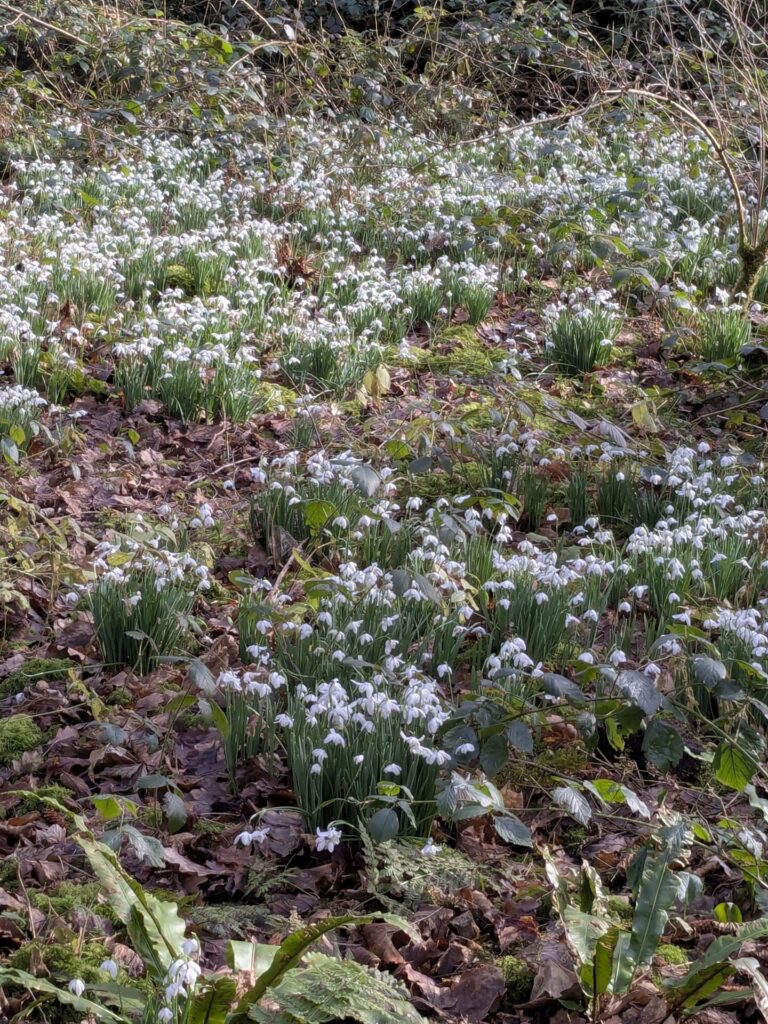
Approximately twenty u3a members of the Visiting Gardens group met on Tuesday, 17th February at Coniston Priory, the Manjushri Centre, Bardsea, for their first visit of the year.
A sunny, clear day greeted us, a welcome tonic during a very wet and dismal winter. Plenty of snowdrops carpeted the grounds with daffodil shoots and wild garlic showing their promise. Birds sang, a jay and a nuthatch (which apparently climbs down tree trunks, dagger-like, beak first) were spotted, plus two cheeky grey squirrels taking on the bare branches.
Coffee and cakes were enjoyed in the café which was buzzing inside and out! We look forward to our next visit in March and perhaps sunshine and warmth to herald Spring. Thanks to Jean Brumby, as organiser for this visit and Mave Clerey for this report.
Our next garden visit will be on Tuesday 17th March when we will be going to Pennington and Kirkby-in-Furness churchyards to see the crocus and daffodils. We will meet at Victoria Road, Ulverston at 9.45 for car sharing. The cost will be £2 payable to drivers for lifts. Mary Wilkinson is organising refreshments for us at the Community Centre in Kirkby but will need to know numbers in advance to do this. To book your place please contact Jeni Sarson .
Jeni Sarson Visiting Gardens
INDUSTRIAL HISTORY GROUP
Industrial History Group Meeting on February 26th 2026
Twenty-eight members met in Gleaston village hall to hear a very interesting talk by Kevin Grice on the industrial history of Millbeck.
Millbeck nestles under the shadow of Skiddaw, approximately two miles north of Keswick. The hamlet of Millbeck was first recorded in 1260.
Millbeck Hall is a very old farmhouse built in the late 16th century around a pele tower. Pele towers were built between 1350 and 1600 AD to provide defensible retreats when villages were attacked by Border Reivers. The date 1592 is carved on a door lintel alongside the name of the owner, Nicholas Williamson. The Millbeck branch of this family were involved with the local copper mines, but a relative became a wealthy lawyer. He was imprisoned in the Tower of London for his part in a conspiracy and was only released after paying the equivalent of several million pounds in today’s money.
In the late eighteenth century and during the nineteenth century the main industries were farming and production of woollen goods. There are the remains of a very early corn mill and a later woollen mill. A sale notice of June 1855 referred to an old and a new carding mill, each containing two engines, a fulling mill with a 22ft in diameter and 3.5ft width water wheel, a raise mill, a brushing mill, a brimstone stove and wet house. There was also an “extensive drying ground and nine good tenters”. Included in the sale were 13 cottages for the workers. At that time, the owners employed 100 people. The woollen material was produced for the less expensive end of the market and was sold at home and abroad. When the Yorkshire mills started using steam power, production increased and Millbeck could no longer compete with them.
The workers cottages remain. The fulling mill has been converted into five cottages. The smithy is now a dwelling, as is an old mill building that until quite recently housed a water wheel. The most unusual building must be Millbeck Towers. Originally this building was an enormous carding mill where water driven, wire-toothed rollers were used to untangle, clean and straighten raw wool fibres. In the late nineteenth century the two ends of the mill were demolished and replaced by unattractive, concrete turrets. However, I believe that the Art Nouveau interior is beautiful. The mill races still run through the large walled garden and a pond remains. The original bell from the top of the carding mill, that kept workers on time, now stands by the front door. Millbeck Towers became holiday accommodation in 1903, and was handed over to the National Trust when the owner died.
Our March visit to Stott Park Bobbin Mill is fully booked, details to follow, and our June visit to Oxleys is also fully booked.
Future visits are:
April 23rd – Devil’s Porridge Museum near Gretna.
May 23rd – Ravenglass and Eskdale Railway and Museum
July 23rd – Silver Howe Rifle Range and Cathedral Cavern
August 27th – Arneside and Silverdale
September 24th – Threkeld Quarry and Mining Museum
If you would like to join us on any of our visits please let Jo White
Jo White Industrial History Group
WORLD HISTORY GROUP
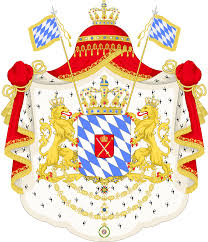
Bavaria – The duchy who wanted to be a Kingdom
In the period leading up to 1815 the country we know as Germany was a collection of states, each with their own ruler. These states were nominally ruled(controlled) by the Holy Roman Emperor but the Princes, Bishops and Dukes of the individual states wielded much power. Some of them had an electoral vote which could be used to vote for the next emperor (influenced by ruling families such as the Habsburgs). The Golden Bull of 1356 reduced the number of Electors to seven and brought some stability.
From the 14th to the 16th century Bavaria was largely fragmented. This was because various members of the Wittelsbach ruling family were able to inherit part of the lands, especially if there were several sons who were heirs.
By aligning with Napoleon in the early 19th century, Bavaria expanded its territory and was elevated to a kingdom in 1806, marking its transition from a fragmented electorate to a centralised modern state. By 1815 Bavaria was the 3rd largest of the German States.
In 1356 the Palatinate, a branch of the ruling Wittelsbach family, was recognized as an elector of the Holy Roman Empire but the state of Bavaria itself was not.
Bavaria was united under one ruler by Duke Albert 1V of Bavaria-Munich. He enacted the principle of primogeniture (eldest son inherits all) in 1506 which largely put an end to the constant division of lands and made Munich the capital.
His son William 1V took over after his death (although he had inherited through primogeniture, for complicated reasons he co-ruled peaceably with his brother Louis for about 20 years). William kept Bavaria staunchly Catholic and opposed Lutheran teachings. A Jesuit College was founded in Bavaria in 1541.
Religious disagreement amongst the German States contributed to the onset of the Thirty Years War, with different countries such as France and Sweden taking sides for religious and political reasons. DukeMaximilian 1 of Bavaria played an important part in the war and earned Bavaria the right to be one of the Electors of the Holy Roman Emperor.
Bavaria was a major battlefield in the War of the Spanish Succession (early 1700s) and the War of the Austrian Succession (1740s), during which Elector Charles Albert (later Emperor Charles VII) attempted to challenge Habsburg dominance.
Following the death of Elector Maximilian III Joseph, the Bavarian line of the Wittelsbachs went extinct. The electorate passed to Charles Theodore (Wittelsbach) of the Palatinate, uniting the Bavarian and Palatine lands.
(1778–1779): Austria tried to annex parts of Bavaria. Prussia intervened to prevent this, resulting in the "Potato War," which solidified the new, united Bavarian territory.
If you are interested in joining the group please contact Rosie Kyles or via World History Group on the Furness u3a website.
SOME OTHER SOURCES OF WIDER U3A NEWS
National u3a Festival 26
Wed 1 Jul 2026 11:00 AM - Fri 3 Jul 2026 3:00 PM
University of York, Heslington, York YO10 5DD
The National u3a Festival 26 is taking place at the University of York and will be an opportunity for fun, learning and making new connections. There will be opportunities to share your skills and learn some new ones in our series of talks, workshops and activities spanning sports, music, art and much more. Drawing on the experience, enthusiasm and talent of u3a members, the Festival is a wonderful celebration of the creativity within the u3a movement.
There's a huge variety of activities on offer - here's a taster of what you can look forward to:
- Sparking new ideas at talks on a wide range of subjects.
- Getting moving at a fitness workshop or in a sports tournament.
- Exploring your creativity with hands-on craft workshops.
- Enjoying live performances by talented u3a musical groups - or have a go at making music yourself.
The Festival begins on Wednesday 1 July and will end on the afternoon of Friday 3 July.
Ticket options are:
- a 3-day ticket
- individual one-day tickets for Wednesday 1, Thursday 2 or Friday 3 July
To find out more look here https://www.u3a.org.uk/what-we-do/events/festival-2026
There are several places where you can catch up on U3A news from further afield.
There is a U3A Friends Group who send out a regular newsletter. You can see the February edition here, and if you would like to subscribe there is a link at the bottom of their newsletter.
There is a U3A YouTube channel U3A
The North West Region of the U3A have their own website, and a quarterly newsletter.
This is the February - April 2026 copy.